Building an operating system for the brain requires more than software. The product must capture clean neural signals during motion, remain comfortable for hours, process data locally without draining batteries, and scale to production volumes; all while maintaining research-grade signal quality.
The IDUN Guardian 4 brain sensing earbuds represent the culmination of three years of engineering and product development focused on one question: what does it take to make brain sensing work in the real world?
How to Acquire Lab-Quality Signals in Real-World Conditions?
Traditional EEG was designed for controlled research environments. Subjects sit still. Technicians apply conductive gel. Signal quality is checked continuously. Any movement artifacts require recalibration.
You can’t do that in the real world.
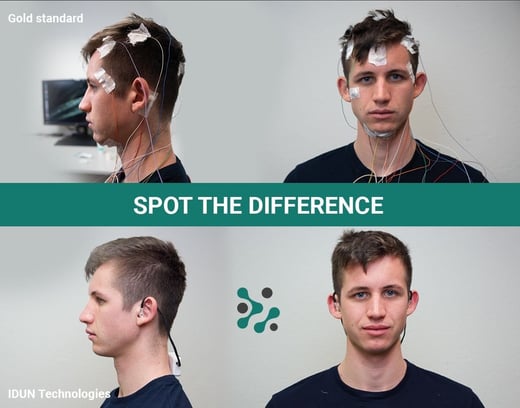
People move. They talk. They commute on crowded trains, work out at the gym, fall asleep in different positions every night. Environmental noise is constant. There's no technician to reposition electrodes or reapply gel. The device must work reliably across all these scenarios without compromising signal quality.
IDUN Guardian 4 was engineered to handle this reality through advances across three critical domains: hardware design, materials engineering, and edge processing.
1. Signal Acquisition: The Analog Devices Front-End
Brain signals captured through the ear canal are remarkably weak—thousands of times smaller than the electrical noise from a smartphone or the motion artifacts from walking. Extracting clean EEG from this challenging environment requires exceptional analog electronics.
IDUN Guardian 4 integrates an Analog Devices (ADI) biopotential front-end specifically optimized for bio-potential signal acquisition. The improvements over IDUN Guardian 3 are significant:
Lower noise floor means that weaker signals, particularly in higher frequency bands like beta and gamma, remain detectable during daily activities.
Higher common-mode rejection suppresses electrical interference from phones, computers, and power lines without requiring extensive post-processing.
Improved impedance tolerance maintains signal quality even when electrode contact varies due to movement, individual anatomy differences, or environmental conditions.
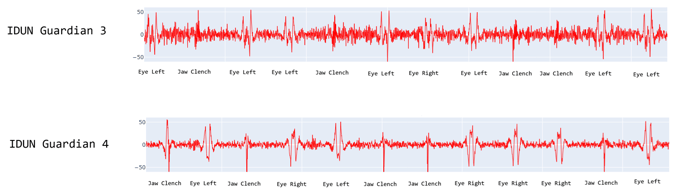 Two recordings in identical experimental conditions; notice the higher SNR on the IDUN Guardian 4 (bottom) than the IDUN Guardian 3 (top)
In validation testing, these improvements were particularly noticeable during activities that challenged IDUN Guardian 3: walking, talking, working out, and commuting. IDUN Guardian 4 archives stable brain sensing and signal quality across all these conditions.
2. Sensor Design: Engineering Comfort and Contact
Signal quality begins at the electrode-skin interface. The Dryode® ear tip sensor in the IDUN Guardian 4 represents the latest evolution of our proprietary electrode material technology, refined through rigorous user study and years of materials engineering.
The refined Dryode® design adapts better to different ear canal shapes, creating more consistent electrode contact across diverse users and their individual ear anatomies. The updated shape reduces pressure points, improving comfort during extended wear.
Material improvements in the Dryode® material formulation make the sensor more comfortable and conformable to different ear canal shapes. The updated material maintains consistent contact throughout the day and night, even as users shift positions during sleep or experience natural perspiration changes.
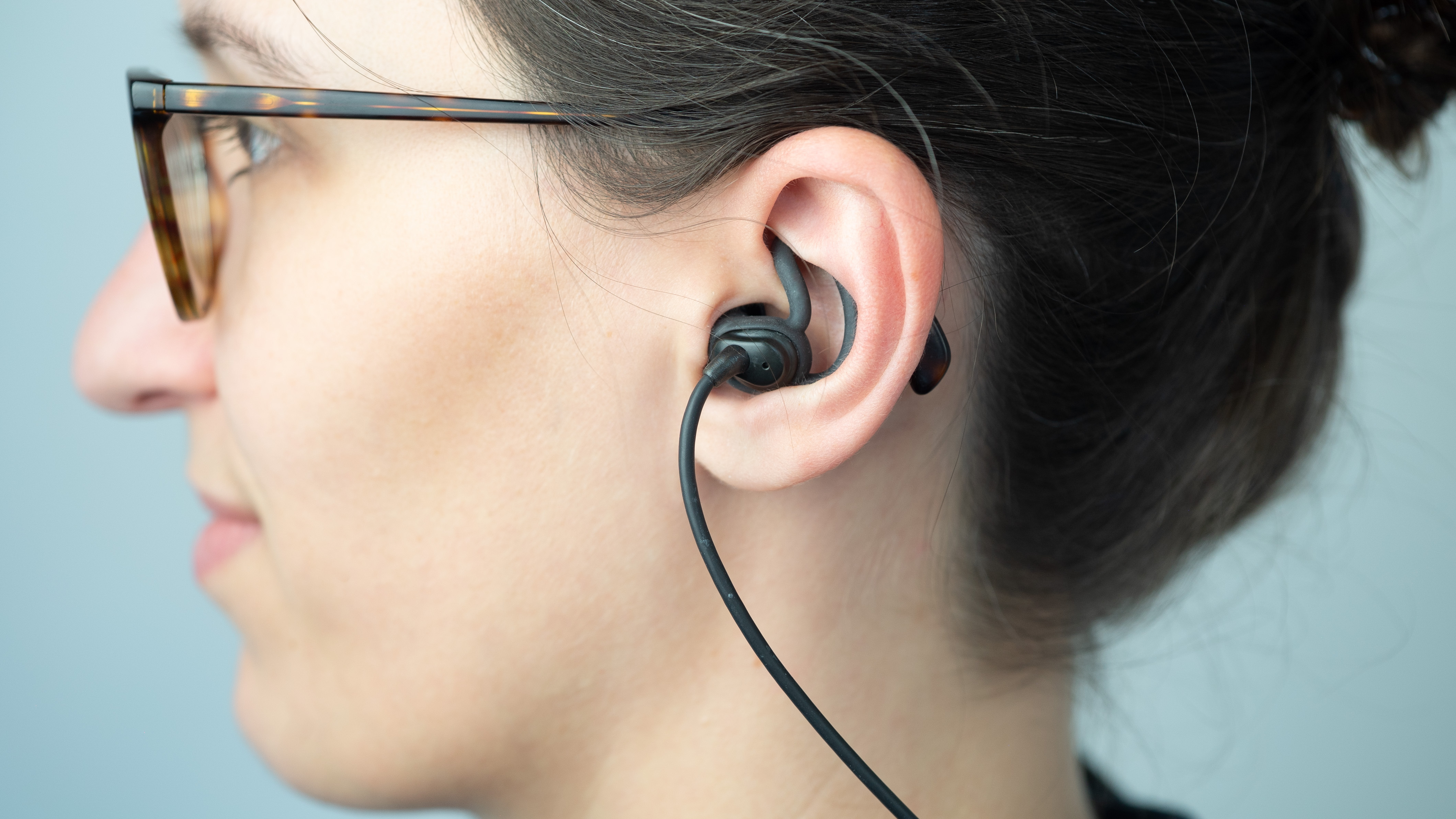
Beyond the ear tip sensor, the overall earbud design features a soft concha wing stabilizer that secures the device comfortably in place. This refined product design, combined with the enhanced Dryode® sensor, helps users achieve optimal fit quickly and maintain it through extended wear—a significant improvement over IDUN Guardian 3.
This matters because in consumer wearables, comfort is not a luxury but an essential: even the most sophisticated signal processing can't compensate for an electrode that loses contact because the user adjusted the device to relieve discomfort.
3. On-Device Processing: The Qualcomm Snapdragon S7 Platform
Real-time neuroadaptive applications require the ability to process brain signals on-device, without cloud latency or connectivity dependencies. IDUN Guardian 4 integrates the Qualcomm Snapdragon S7 Sound Platform, enabling a new generation of wearable brain-computer interfaces with on-device processing and enhanced user data protection:
Audio integration allows simultaneous brain sensing and audio playback—essential for neuroadaptive audio applications where the device must both measure brain response and modulate sound in real-time.
Edge classifiers run directly on the device, enabling low-latency biosignal processing for brain activity as well as IDUN’s Hand’s Free UX Control algorithms that detect jaw clenches and horizontal eye movements. This opens up a whole new control method for users and their earbuds.
ML model support enables more sophisticated on-device inference as algorithms mature. The S7 platform's computational capacity supports models that would have required cloud processing on IDUN Guardian 3.
Power efficiency allows the IDUN Guardian 4 to be used daily like normal earbuds even with continuous EEG recording and on-device processing—a balance that required extensive optimization.
Validation: From Lab to Real World
Engineering claims require validation. IDUN developed a comprehensive testing framework to benchmark the IDUN Guardian 4 earbuds against both the IDUN Guardian 3 and research-grade brain-computer interfaces:
Signal quality validation measured noise performance, frequency resolution, and artifact rejection across controlled and real-world scenarios. The IDUN Guardian 4 met or exceeded IDUN Guardian 3's validated performance across all metrics.
Comfort and usability testing tracked setup time, wearing duration, and how often adjustment was required across diverse users. The IDUN Guardian 4 showed consistent improvements, particularly for first-time users and extended wear periods.
Real-world application testing validated complete workflows—sleep tracking, cognitive load measurement and attention detection in real-world conditions, not just controlled lab scenarios.
Results are consolidated into structured reports that partners use for internal evaluation and integration planning.

What This Engineering Enables
These product improvements aren't ends in themselves—they're enablers for neuroadaptive applications:
Neuroadaptive audio that responds to attention, cognitive load, or emotional state requires clean signals during audio playback. IDUN Guardian 4's audio integration and signal quality make this possible.
Continuous cognitive monitoring for productivity, learning, or wellness applications requires comfortable all-day wear. IDUN Guardian 4's sensor improvements deliver this.
Offline brain-computer interfaces for environments without connectivity require on-device processing. IDUN Guardian 4's Qualcomm platform enables this.
Scalable manufacturing for broader market access requires design-for-manufacturing optimization. IDUN Guardian 4's engineering supports production volumes that IDUN Guardian 3 couldn't achieve.
From Reference Design to Integration
For OEM partners, IDUN Guardian 4 offers flexible integration options. The platform can be adapted to different form factors, customized for specific applications, or integrated into existing product lines—all while maintaining the validated signal quality that makes brain sensing reliable.
This flexibility is what transforms IDUN Guardian 4 from a research device into a platform.
What Comes Next
The IDUN Guardian 4 establishes the engineering foundation for an ecosystem of neuroadaptive products and applications. The audio integration, power efficiency, and signal processing advances make entirely new categories of brain-computer interfaces practical and accessible for consumers.
For developers and partners, this means the platform is ready: validated signal quality, on-device processing, comfortable form factor, scalable manufacturing. The engineering challenges that kept brain sensing confined to labs have been solved.
What comes next is up to the applications you build on this foundation. This January 6-9, join us and our partner ADI at CES as we set out for that final frontier, together. You can book to meet us right here: Meet us at CES 2026
Experience the IDUN Guardian 4 at CES 2026, January 6-9.