On New Year's Eve 2026, a fire at a crowded bar in Crans-Montana, Switzerland, killed 41 people and seriously injured over 115 others. The tragedy prompted a national day of mourning, an international criminal investigation, and an overhaul of safety regulations.
Among those affected were the first responders, such as the paramedics who spent hours performing triage and transporting casualties. Fifteen days after the incident, one 32-year-old advanced paramedic was still on medical leave with severe acute stress symptoms. Her partner reported that she had night terrors (which she didn't remember), dissociative episodes, severe body tension, and memory problems.
When our partner Pierre Vernay, a wellness founder and former paramedic himself, learned about this paramedic's suffering, he wanted to help. He offered her an integrative somatic therapy intervention, during which she agreed to wear the IDUN Guardian in-ear EEG device.
What followed demonstrates what becomes possible when neurophysiological measurement moves from the laboratory into real-world therapeutic settings.
Electroencephalography (EEG) measures electrical brain activity through electrodes. For nearly a century, this has required specific infrastructure: conductive gel for electrode contact, precise placement following standard montages, expensive amplification equipment, shielded rooms to reduce interference, and trained technicians for setup.
Participants must remain relatively still to avoid motion artifacts. The entire apparatus makes traditional EEG impractical outside controlled laboratory or clinical environments.
For trauma therapy, this creates a fundamental constraint. While trauma survivors need environments where they feel safe and maintain control; laboratory settings, with their unfamiliar, clinical, and equipment-heavy feel, activate the very nervous system responses that trauma therapy aims to calm.
The in-ear EEG approach removes these barriers: no gel, no wires, no stationary positioning required. Just earbuds that record brainwaves during natural movement and therapeutic activities.
According to standardized psychological measures, the paramedic showed significant impairment. In addition to temporary anxiety (58/80 on STAI-S, where 40 is the threshold of clinical relevance), she was given the PCL-5 test to screen for post-traumatic stress disorder (PTSD). The results were as follows:
This adds up to a score of 34/80, exceeding the screening threshold of 31-33 for PTSD.
The symptom profile was revealing. She scored high in clusters C and D, suggesting she was actively avoiding the negative emotions caused by reminders of the trauma. However, her cluster E score was lower, suggesting her nervous system could downregulate when given the right conditions.
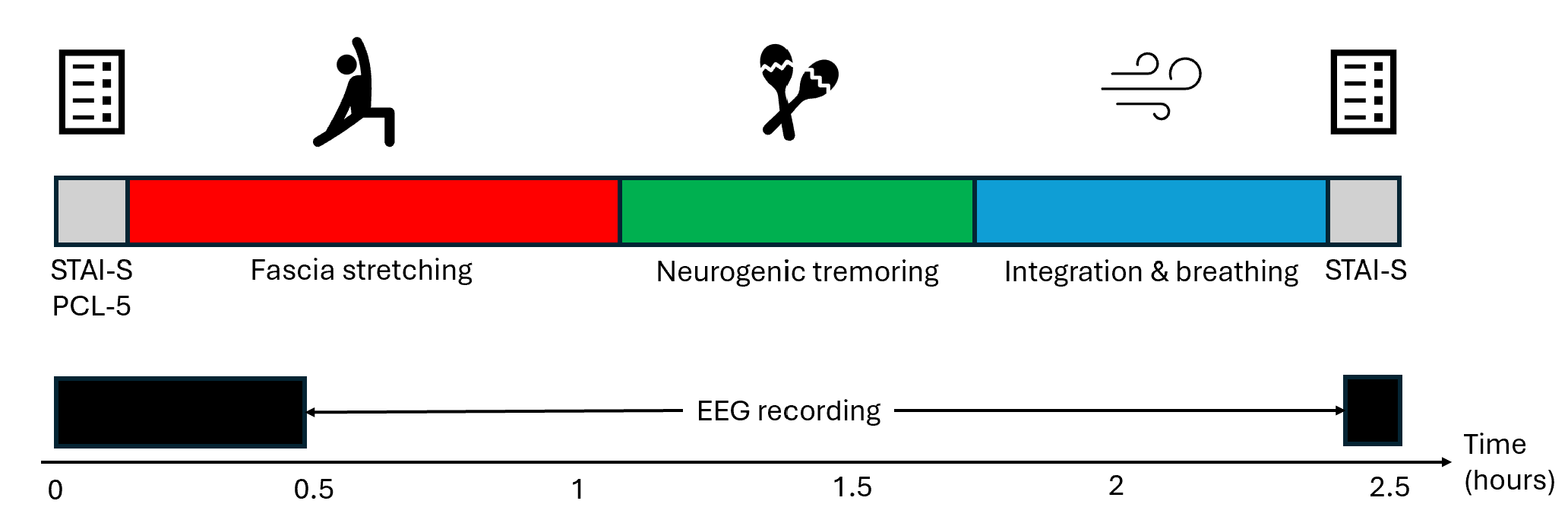
Pierre's intervention combined three therapeutic modalities delivered sequentially:
Additionally, she was given a structured aromatherapy sleep protocol for daily self-administration between sessions; the protocol targeted general sleep, NREM, REM, and circadian rhythm support.
Of the 2.5 hour session around 30 minutes of the paramedic's EEG signals were recorded by the IDUN Guardian, capturing 28 minutes 46 seconds of intervention data and 3 minutes 43 seconds of post-session rest.
What the Brain Data Showed
While the EEG recordings didn't capture the entire 2.5-hour session, they documented distinct neurophysiological states that corresponded with the therapeutic process and psychological measures.
Pre-Session: Anxious Activation
During the baseline questionnaire period, the participant sat upright, writing responses. This represented her natural anxious state—the elevated State Anxiety score of 58/80 reflecting what her nervous system looked like under stress. The brain activity during this phase showed elevated beta frequencies (13-30 Hz), a characteristic pattern of active, anxious cognitive processing.
During Intervention: Deep Relaxation Patterns
The 28 minutes 46 seconds of intervention recording showed a markedly different pattern of brain activity. Power spectral analysis revealed dominant delta (0.5-4 Hz) and theta (4-8 Hz) frequencies, while beta activity progressively reduced during the recorded segments. The activity sensor confirmed sustained supine positioning with minimal movement during these phases.
Delta and theta dominance, combined with reduced beta, represents a profound shift from the anxious, activated pre-session state. These slow-wave patterns are typically associated with deep relaxation, restorative states, and the hypnagogic threshold between waking and sleep. This suggested parasympathetic activation, the nervous system downshifting from its baseline state of threat vigilance into genuine relaxation.
Post-Session: Calm Awareness
Approximately 2.5 hours after the intervention ended, a brief recording captured something different: prominent, sustained alpha activity (8-12 Hz).
Alpha is the signature of calm, wakeful awareness—not the anxious arousal of the pre-session state, not the deep relaxation of the intervention, but genuine neurophysiological settling. Reduced beta compared to the pre-session baseline confirmed the shift.
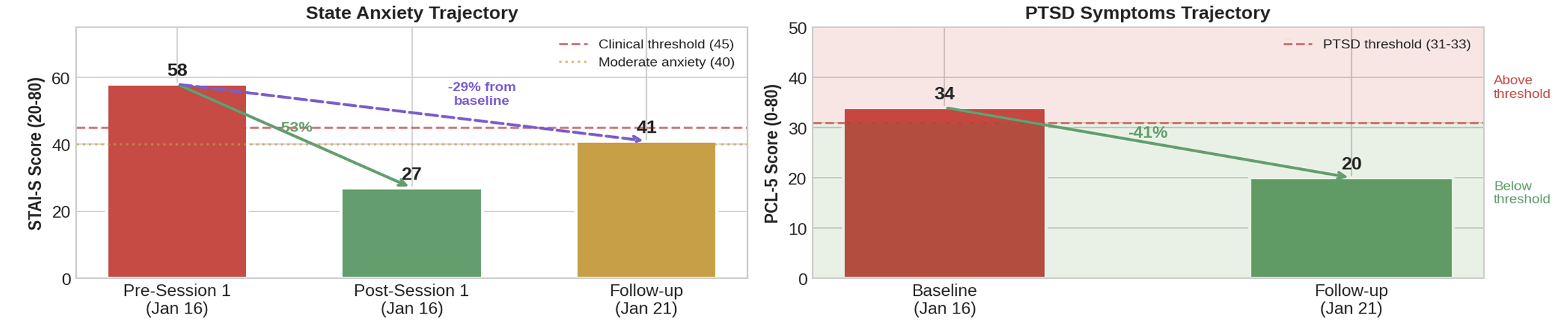
The psychological measures matched the brain state changes. Within one day, her State Anxiety score had dropped from 58 to 27, a 31-point reduction (easily exceeding the clinically significant change threshold of 10 points) representing a shift from clinical-range anxiety to low-normal levels.
Three Distinct Brain States
The EEG data documented three neurophysiologically distinct states:
- Pre-session: Beta-dominant (anxious activation)
- During intervention: Delta/theta-dominant, reduced beta (deep relaxation)
- Post-session: Alpha-prominent, reduced beta (calm awareness)
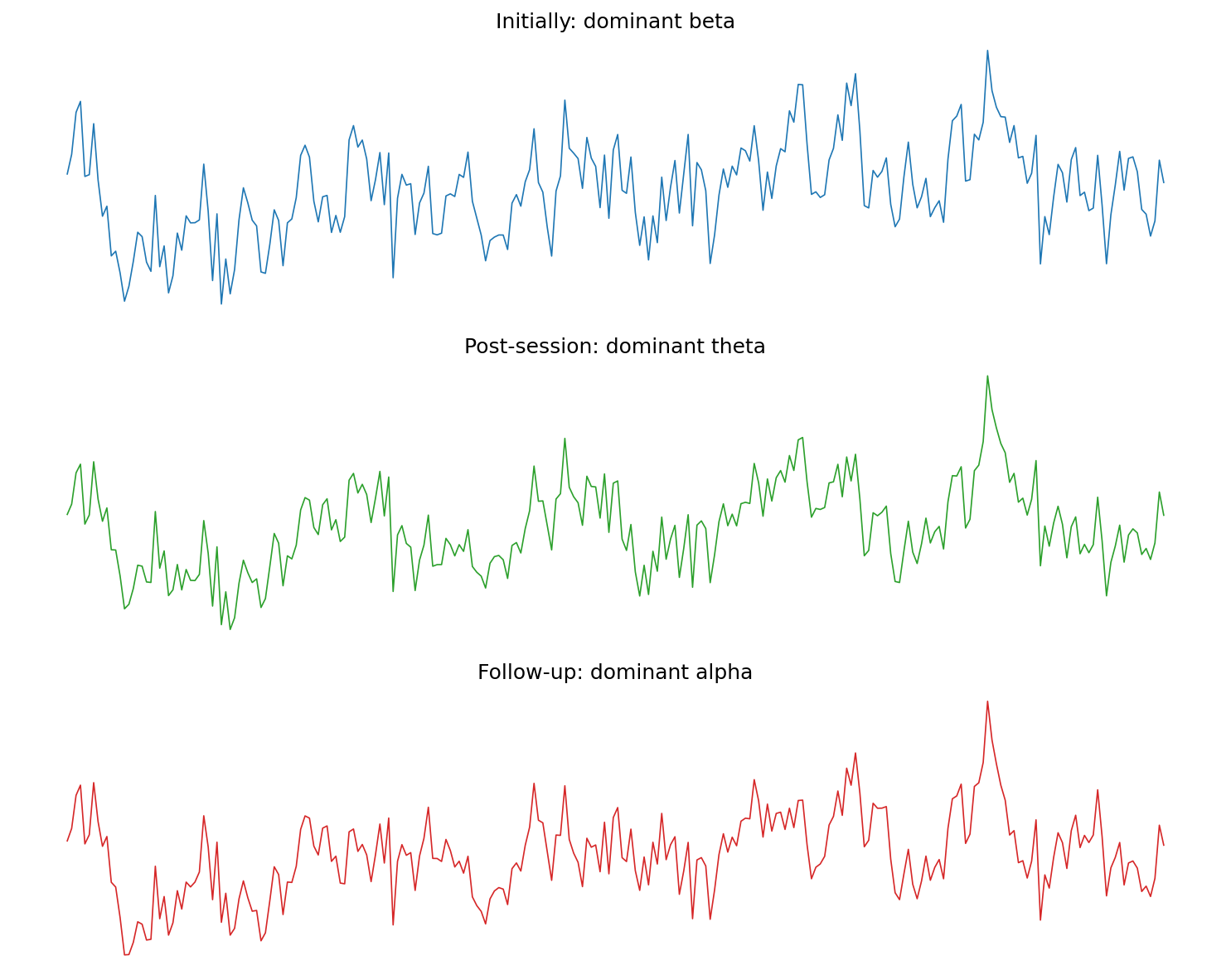
While we don't have continuous recording showing how these transitions unfolded, the captured segments demonstrate that the brain states during and after intervention were measurably different from the anxious baseline. Furthermore, they were confirmed by the psychological tests.
The Five-Day Question: Did It Last?
Acute effects after therapeutic sessions are common. The critical question is durability. Five days later, the participant was reassessed with the same standardized measures.
Her State Anxiety was 41 out of 80—higher than the immediate post-session low of 27, but still below her original baseline of 58. The improvement had partially regressed but remained clinically significant.
More importantly, her PCL-5 screening score had dropped from 34 to 20, which moved her below the screening threshold, suggesting her symptoms no longer warranted urgent clinical evaluation for probable PTSD.
The pattern of symptom change across the four clusters was revealing:
| Symptom Cluster |
Baseline |
Day 5 |
Change |
| B: Intrusion (/20) |
7 (35%) |
9 (45%) |
+2 |
| C: Avoidance (/8) |
5 (63%) |
1 (13%) |
-4 |
| D: Negative Cognitions (/28) |
14 (50%) |
8 (29%) |
-6 |
| E: Arousal (/24) |
4 (17%) |
2 (8%) |
-2 |
Avoidance collapsed. From 63% severity to just 13%. She was no longer actively avoiding reminders of the trauma—a core feature of PTSD that had essentially resolved.
Dissociation resolved. The specific item measuring "feeling distant or cut off from others" dropped from 3 out of 4 to 0. This matched her subjective report of feeling grounded and present.
Negative cognitions improved substantially. From 50% to 29% severity. Her ability to experience positive emotions and connection had measurably increased.
Intrusion symptoms slightly increased. Counter-intuitively, intrusion symptoms rose from 7 to 9 out of 20. This may reflect reduced avoidance allowing more processing—when you stop pushing memories away, they can surface more. This is not necessarily pathological and can be part of healthy trauma integration.
Arousal remained well-regulated. These symptoms dropped from 4 to 2 out of 24, remaining in the low range. No hypervigilance, no sleep disturbance reported.
Her partner's observations confirmed the psychological measures. The night terrors that had occurred every night for fifteen days had stopped. Only minor agitation was observed on the final night of the follow-up period.
She reported feeling "way better"—grounded, no longer dissociating, with appropriate emotional distance from the traumatic event. She acknowledged that the incident had "opened a fragility" requiring continued care, but this was realistic assessment, not catastrophic thinking. She was planning to return to work part-time, pacing her recovery appropriately.
What Accessible Measurement Enables
This case demonstrates several capabilities that emerge when neurophysiology moves outside controlled laboratory settings.
Convergent Evidence Across Modalities
The alignment between subjective reports ("I feel grounded"), standardized screening measures (anxiety scores, PTSD symptoms), and neurophysiological data (delta/theta during intervention, sustained alpha post-session) provides multi-modal validation. When measurement streams converge, confidence in the findings increases substantially—even when the neurophysiological recording is incomplete.
Documenting State Changes in Real-World Settings
The brain state transitions—from anxious beta activity to deep delta/theta relaxation to sustained alpha recovery—correspond with therapeutic phases and subjective experience. While we don't have continuous recording throughout the full 2.5-hour session, the captured segments show clear neurophysiological shifts that traditional pre-post questionnaires administered days apart would miss entirely.
Capturing What Self-Report Misses
The participant had no memory of her night terrors—a documented feature of dissociative amnesia in acute stress reactions. Without her partner's observations and the structured follow-up protocol, this critical indicator would have been invisible. The combination of in-ear EEG monitoring (even partial), psychological screening, and partner observation captured changes the participant herself couldn't report.
Enabling Practitioner Innovation
Pierre could deliver his multimodal protocol in a comfortable, private setting while obtaining neurophysiological documentation that would typically require a university laboratory. This enables systematic validation of integrative approaches that have historically operated outside the formal evidence base.
For practitioners working at the intersection of traditional healing modalities and contemporary neuroscience, the validation gap has been significant. Not because they don't value rigor, but because the technology wasn't accessible. When brain sensing becomes as simple as wearing earbuds—even if recording isn't continuous throughout an entire session—practitioners can begin documenting their work in ways that clinical observation alone cannot provide.
Limitations and Appropriate Cautions
Scientific integrity requires acknowledging what this case study cannot establish.
Single-Subject Design
This is one person's response to one intervention at one moment in time. No causal inference is possible. No generalizability claims are warranted. The trajectory is encouraging, but it's preliminary data requiring replication across multiple participants.
No Control Condition
Placebo effects, expectancy effects, and non-specific therapeutic factors cannot be ruled out. State anxiety responds to many things: perceived safety, warmth, focused attention, permission to rest, breathing regulation, physical touch, positive expectation, and the structure of receiving care. All were present.
Multimodal Intervention Confounds
The protocol combined fascia work, tremoring, aromatherapy, and therapeutic alliance. It's impossible to determine which components were necessary, sufficient, or most active. The observed effects could be driven by one element, by their synergy, or by non-specific factors entirely.
Incomplete EEG Recording
While the IDUN Guardian was worn throughout the 2.5-hour session, only 28 minutes 46 seconds of usable EEG data was captured during the intervention. The documentation doesn't specify which phases of the therapeutic protocol were recorded or whether the recording was continuous or intermittent. This limits what can be claimed about "continuous monitoring" and means the neurophysiological findings represent snapshots rather than complete documentation of the session.
Moderate Signal Quality
The EEG recordings showed 49-51% signal quality—adequate for analysis but lower than laboratory standards. Single-channel in-ear recording provides limited spatial resolution compared to multi-channel research systems. These are acceptable trade-offs for real-world applicability, but they affect measurement precision.
Screening Tools, Not Diagnosis
The PCL-5 is a screening instrument and symptom severity measure, not a diagnostic tool. Scores above 31-33 suggest probable PTSD warranting clinical evaluation; scores below this threshold indicate symptoms may not meet diagnostic criteria. However, only structured clinical interviews using DSM-5 criteria can establish formal PTSD diagnosis. This case study documents symptom severity changes, not diagnostic status changes.
Short Follow-Up Period
Five days is insufficient to assess long-term durability. We don't know if improvements will persist at one month, three months, or six months. The State Anxiety score showed partial regression from the immediate post-session low, suggesting continued tracking is essential.
Mechanisms Remain Unclear
The observed improvements could result from specific somatic techniques, olfactory effects on limbic structures, breathing-mediated autonomic modulation, non-specific therapeutic factors, or synergistic combinations. Without controlled component analysis, we can document change but not explain it definitively.
Note on Baseline Stability
The 15-day post-trauma assessment period strengthens confidence in the baseline. Unlike a measurement taken at an acute moment, the participant had experienced sustained symptoms for over two weeks—consistent enough to warrant continuous medical leave. Her partner reported nightly disturbances throughout this period. This represents an established symptomatic baseline rather than a transient peak, making regression to the mean less likely as an explanation.
What Would Strengthen Evidence
To move from preliminary observation toward validated intervention:
- Continuous EEG recording throughout full therapeutic sessions (or clear documentation of which phases are recorded)
- Consistent dose-response pattern across multiple sessions
- Downward trending baseline scores over weeks/months
- Replication across multiple participants
- Controlled studies isolating active protocol components
- Longer follow-up periods (weeks to months)
- Structured clinical interviews to confirm diagnostic status changes
From Documentation to Systematic Validation
The path from "this helped one person" to "this is an evidence-based intervention" requires multiple levels of evidence. This case study provides preliminary documentation with appropriate scientific humility about what can and cannot be claimed.
What made this documentation possible was not institutional infrastructure or research funding, but accessible technology. Pierre Vernay needed a therapeutic protocol, a willing participant, and measurement tools that function in real-world conditions. No gel electrodes, no laboratory, no technical support team. The in-ear EEG could be worn during therapeutic work in a private, comfortable setting—even if the recording captured segments rather than the complete session.
This is what the democratization of neuroscience looks like: enabling practitioners outside traditional research settings to document their work with neurophysiological data. Not replacing rigorous research, but providing preliminary evidence that makes larger studies worth conducting. Not eliminating the need for randomized controlled trials, but establishing that an effect worth investigating exists.
First responders who witness repeated trauma deserve interventions backed by evidence. But evidence has to start somewhere—with practitioners willing to measure their work and tools willing to meet them where they are.
When brain sensing leaves the laboratory and enters therapeutic spaces, systematic validation becomes possible for approaches that have historically operated on clinical observation alone. The results documented here—53% immediate anxiety reduction, 41% symptom improvement at five days, resolution of avoidance and dissociation—warrant continued investigation with more rigorous methodology.
The future this case points toward isn't perfect evidence. It's the infrastructure that makes evidence possible: measurement tools that work in real-world settings, practitioners willing to document their innovations, and participants willing to contribute their data to advancing therapeutic knowledge.